

Field Report · Grading
How to Grade Pokémon Cards in South Africa
What it costs in rands, which company to pick, how long it takes and how to pack your cards – everything you need to get a card slabbed by PSA, CGC, Beckett or AGS from South Africa.
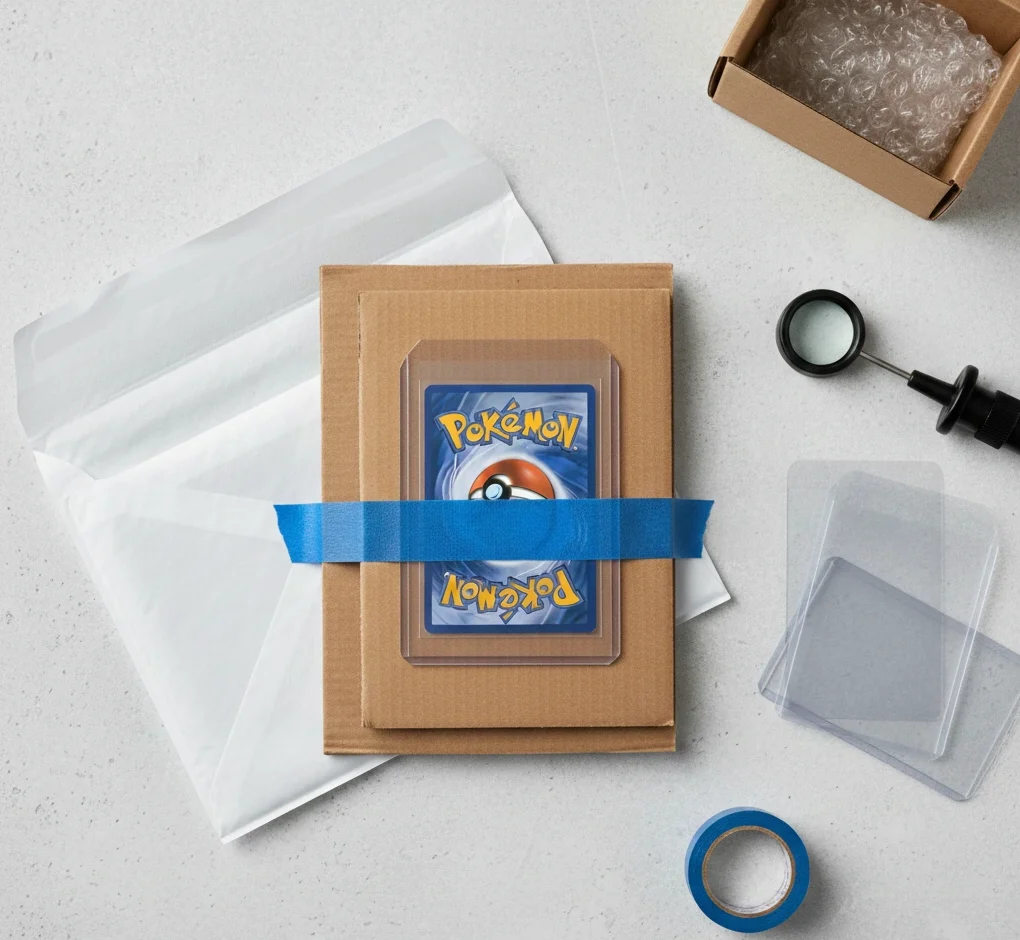
You've pulled a heavy hitter – the kind of card that makes your heart race. In today's market, a raw card is often just potential. To unlock its value and protect it for decades, you need a "slab". There are no grading companies based in South Africa, so every card makes a round trip to the USA. Here's exactly how that works, what it costs and how to avoid the mistakes we see most often.
The short version
Most South African collectors grade through GradeIt, a local middleman that batches cards and sends them to PSA, CGC, Beckett (BGS) and AGS. You build your submission online, drop off or courier your cards to them in Johannesburg or Cape Town, and they handle the shipping, import and return. Budget from R400 a card (CGC or AGS) up to around R1,800 for PSA right now, plus 17% customs and R45 return shipping per card. Expect to wait three to four months.
Phase 1
The pre-submission inspection
Grading is an investment, so do your homework first. The difference between a PSA 9 and a PSA 10 – or a Beckett 9.5 and a Black Label – can be thousands of rands. Before you ship anything, become the judge yourself.
Don't rely on the naked eye. Use a centering app (we like Card Centering Calculator), get a second opinion, or use a 10x jeweller's loupe. Hold the card under a bright LED light and tilt it at different angles – it's the only way to catch faint scratches and print lines.
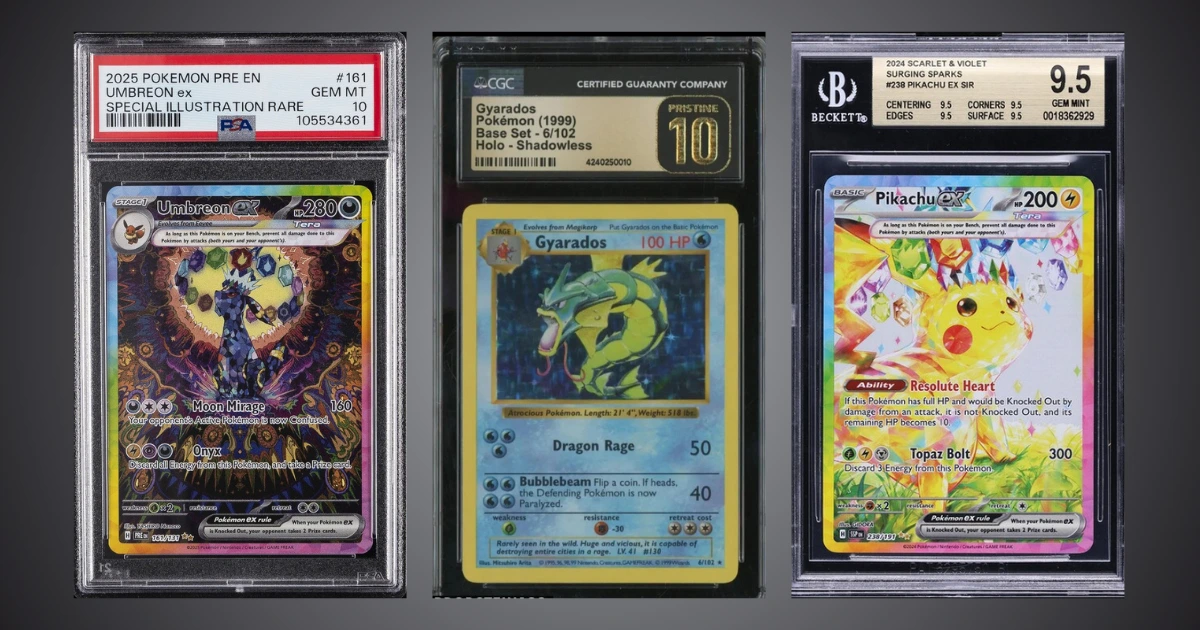
What graders look at
- Centering: how evenly the artwork sits inside the borders, front and back. Each company has its own standard. Since 2025, PSA needs about 55/45 on the front and 75/25 on the back for a 10, measured both side-to-side and top-to-bottom. It's often the thing that decides a 9 versus a 10.
- Corners: all four are checked for whitening, fraying, dings or rounding. One tiny ding can drop a card to a 9 or lower.
- Edges: look along the long and short sides for chipping or whitening – the little white flecks in the blue border on the back.
- Surface: check for dents, scratches, scuffs and factory print lines running across the foil.
Check the numbers before you commit
Next, look up what the card actually sells for once graded. Use recent sold listings on eBay, or PriceCharting, which shows raw and graded prices side by side for each company. For raw prices, TCGplayer is the quickest check, and apps like Collectr let you scan and track your whole collection.
Our rule of thumb: take the graded price at the grade you realistically expect (a 9, not the 10 you're hoping for), subtract the raw price, and see if what's left comfortably beats your all-in cost per card. If it doesn't, the card is probably better off in a binder – unless it's one you simply want to keep forever.
Should you clean your cards first?
GradeIt doesn't clean cards, so any cleaning is up to you – and less is more. A very light wipe with a microfibre cloth removes fingerprints and dust, but go gently on textured and holo finishes, which scratch easily. For stubborn grime, a cotton bud with the tiniest bit of plain water (no chemicals) is as far as we'd go. Let it dry fully, then put it straight into a fresh penny sleeve.
PSA grades explained
| Grade | Label | What it means |
|---|---|---|
| PSA 10 | Gem Mint | Virtually perfect: about 55/45 centering or better on the front (75/25 back), sharp corners, full gloss. |
| PSA 9 | Mint | Superb, with one minor flaw such as a tiny print spot or slightly looser centering (about 60/40 front, 90/10 back). |
| PSA 8 | NM-MT | High-end, but may show slight corner fraying or very minor surface marks. |
| PSA 6–7 | EX-MT to NM | Visible surface wear, light whitening or minor edge chipping. |
| PSA 1–5 | Poor to EX | Heavy wear, creases or staining – usually "binder filler". |
See the full criteria in PSA's official grading standards. The other companies use a similar 1–10 scale, with a special top grade above the normal 10: CGC's Pristine 10, Beckett's Black Label (all four subgrades at 10) and AGS's Legendary 10.
Phase 2
Choosing a grading company
There's no single "best" grader – it depends on what the card is worth and whether you plan to sell it or keep it. Here's how the options available from South Africa compare (prices are GradeIt's base price per card as of October 2026).
| Company | From (per card) | Rough turnaround | Best for |
|---|---|---|---|
| PSA | R600 base, about R1,800 at the moment | 90–100 working days | High-value cards you might sell. PSA 10s usually fetch the biggest premium for Pokémon. |
| CGC | R400 | ~90 days | Bulk modern hits and personal collection cards. Best value per slab. |
| Beckett (BGS) | R600 base, R1,850 for Express | ~30 days on Express | Cards with near-perfect centering and surfaces, where a Black Label is on the table. Express includes subgrades. |
| AGS | R400 | ~30 days | Fast, cheap grading. A newer company built around automated grading, so slabs don't carry the same resale weight as PSA yet. |
| TAG | R650 | ~90 days | Paused at GradeIt until further notice. |
Why is PSA "about R1,800" when the base is R600? PSA's cheaper Value tiers are closed to GradeIt at the moment, so the only open option is the Standard tier at R600 + R1,200. Beckett is similar: its Standard tier is unavailable and Express (R600 + R1,250) is the default. These change often, so check the live prices on GradeIt's site before you plan a submission.
Phase 3
What grading costs from South Africa
The grading fee is only part of the bill. Here's everything that goes into the final number:
- Grading fee: the base price for your company (above), plus extra for any faster tier.
- Return from the USA: a flat 17% customs charge and R45 shipping per card, both added at checkout. Every company GradeIt uses for cards is in the USA, so this applies to all of them.
- Getting your cards to GradeIt: free if you drop off, otherwise whatever your courier charges.
- Getting your slabs back: collect them, or choose "Ship back" at checkout and they're sent to you insured.
- Add-ons: metal cards cost extra (+R150 at PSA, Beckett and AGS, +R50 at CGC), as do PSA jumbo cards (+R200). Putting Beckett subgrades on the label is +R50, and CGC charges +R125 for an error or miscut designation.
- Bulk discount: 12 or more items in one order get 5% off automatically.
- PSA upcharges: a possible extra fee after grading if your card turns out to be worth more than your tier allows (see below).
Worked example: 12 modern hits to CGC
12 × R400 = R4,800 in grading fees, and the 5% bulk discount brings that to R4,560. Add R540 return shipping (12 × R45) and you're at about R425 a card, before the 17% customs and your courier fee to get the parcel to GradeIt. That's why we suggest saving up a stack of cards and sending them together, rather than one at a time.
Phase 4
Submitting through GradeIt
GradeIt calls itself South Africa's first official card-grading middleman service, and it's what we use. They send to PSA, CGC, Beckett and AGS (TAG is paused for now), so you don't have to deal with international shipping, customs or insurance yourself.
The GradeIt process
- Build your submission: on GradeIt.co.za, add your cards one by one. You can search the TCGplayer database for each card or upload your own photo, and pick a service level per card. The total updates as you go.
- Check out and pay: choose "Collect" or "Ship back" – this only affects how your slabs come home.
- Get your cards to them: once you've paid, you'll get an email with the drop-off and send-in options. Drop off in Midrand (Johannesburg) or Durbanville (Cape Town), or courier them with PostNet, Aramex or The Courier Guy. If you're couriering, they prefer parcels to go to the Johannesburg branch.
- Off to the grader: your cards go out with that month's batch for your company. They're kept in the order you submitted them, so you get your own cards back.
- Collect or receive: GradeIt lets you know when your slabs land, or ships them to you insured.
Don't miss the monthly cut-off
This is the part that catches most first-timers. GradeIt doesn't send to every company every month. PSA goes every month, and the second slot rotates between CGC, Beckett and TAG. Every third PSA month (currently November, February, May and August) opens all PSA categories, including Value Max, jumbo cards, autographs and vintage TCG.
Each company has a cut-off countdown at the bottom of GradeIt's site. Miss it and your cards wait for that company's next batch, which can add a month or more to your wait. Check which month your company goes before you pay.
Phase 5
Watch out for PSA upcharges
Each PSA service tier covers cards up to a maximum value. You pick the tier based on what you think the card will be worth after grading. If PSA decides the graded card is worth more than your tier's limit, they move it to the correct tier and charge the difference. It's a standard part of PSA's process – GradeIt has no control over it and passes it on to you.
The key thing: it's based on value, not the grade alone. A modern card can get a PSA 10 and still be worth under $500, so no upcharge. A rare vintage card can get a PSA 7 and be worth well over $500, so it might be upcharged.
| PSA moves your card to | Value once graded | Rough upcharge |
|---|---|---|
| Value | $300–$500 | ≈ R600 |
| Value Max | $501–$1,000 | ≈ R750 |
| Regular Express | $1,001–$1,500 | ≈ R2,300 |
| Express | $1,501–$4,000 | ≈ R5,100 |
⚠ Budget for it on big cards
If you're sending a card you think could be worth a lot, submit it in a higher tier from the start – the difference you'd pay later is smaller. And if you do get an upcharge, take it as good news: it usually means your card is worth more than you expected. It doesn't guarantee a 10, though.
Phase 6
Packing the "cardboard sandwich"
From South Africa to the grading company is a long trip. Good packaging isn't only about safety – it also lets GradeIt check your cards quickly without risking damage.
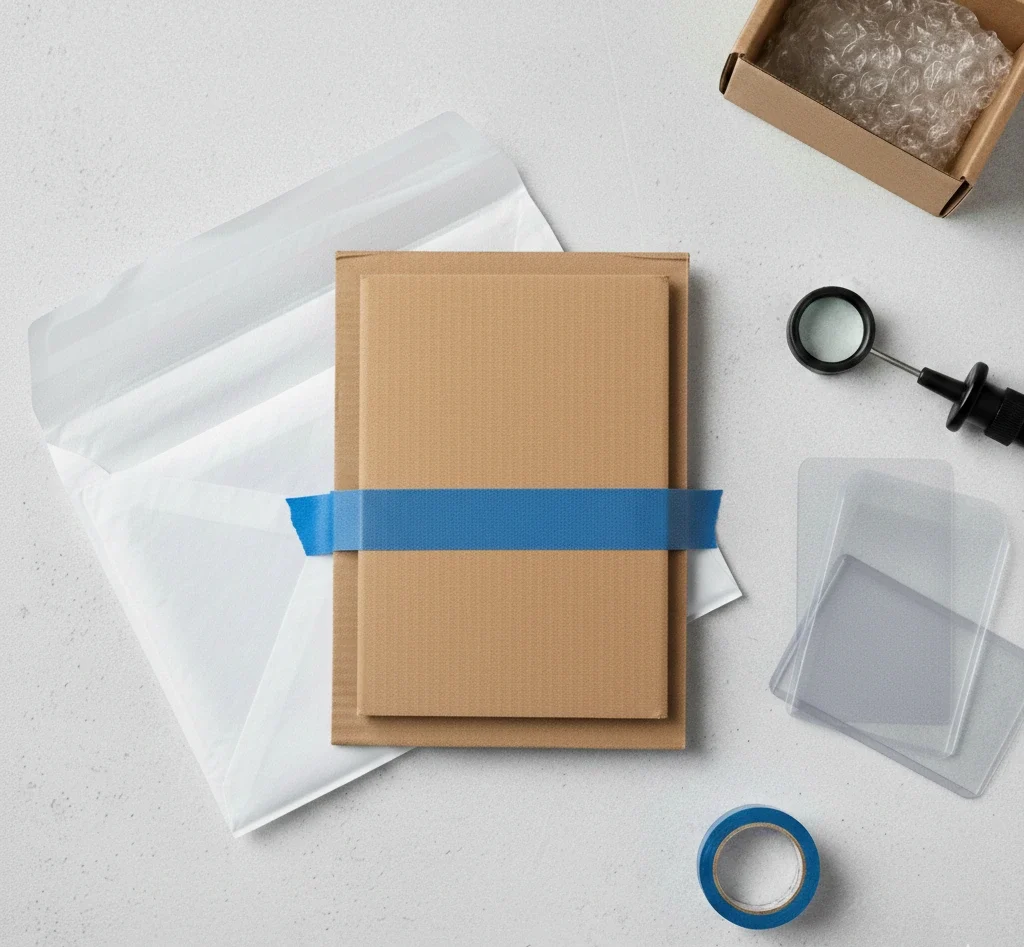
- Penny sleeve: essential – no card should touch a holder unsleeved. Use a soft sleeve such as Ultimate Guard Classic Soft Sleeves. Avoid tight perfect-fit sleeves: the card has to be taken out, and a tight sleeve can cause edge wear.
- Semi-rigid holder: this is what graders want, because cards slide out easily. GradeIt sells its own semi-rigids, and if you use them your cards go to the grader exactly as you packed them. If you send something else, they'll repack each card into a fresh penny sleeve and semi-rigid for you.
- Or a toploader: a 35pt toploader works fine for the trip to GradeIt – just tape the top so the card can't slide out.
- The sandwich: place the holders between two pieces of rigid cardboard slightly larger than the cards.
- Tape: painter's or masking tape holds it together without sticky residue.
- Outer packaging: a padded envelope or small box, sent with a tracked courier. Damage caused by poor packaging is your responsibility.
- Your order number: write it on the parcel and put a note inside. A box with no order number is a mystery parcel, and mystery parcels get delayed.
Once your slabs come back, protect them with resealable graded card sleeves to keep the cases scratch-free.
Phase 7
How long grading takes from South Africa
Plan on three to four months from cut-off to slab in hand. GradeIt says most submissions come back in around 90 days, and gives a rough estimate of 120 working days for all companies unless you pay for a faster tier. That figure covers the grading and the shipping both ways – the international legs alone add roughly 20 to 25 days.
- Fastest: AGS and Beckett Express, at around 30 days at the grader.
- Middle: CGC at around 90 days.
- Slowest: PSA at 90–100 working days on the Standard tier.
None of these are guaranteed. Grading companies' backlogs go up and down, and a big release or a busy holiday season can slow everything down.
The Grunt's final advice
Patience is key. Once your cards are in, there's no need to chase GradeIt for updates – they'll let you know when your slabs are back. Use the wait to start setting aside cards for your next submission.
FAQ
Grading in South Africa: quick answers
How do I get Pokémon cards graded in South Africa?
Use a local middleman such as GradeIt: build your submission online, pay, then drop off or courier your cards to them in Johannesburg or Cape Town. They send them to the grader and handle the return.
How much does it cost to grade a Pokémon card in South Africa?
From R400 a card for CGC or AGS, R600 base for PSA or Beckett (about R1,800 for PSA right now), plus 17% customs and R45 return shipping per card. 12 or more cards get 5% off.
How long does card grading take from South Africa?
Usually three to four months door to door. AGS and Beckett Express are faster, around 30 days at the grader.
Which grading company is best for Pokémon cards?
PSA for high-value cards you might sell, CGC for bulk modern cards, Beckett if you want subgrades or a shot at a Black Label, and AGS if speed and price matter most.
What centering does PSA need for a Gem Mint 10?
Roughly 55/45 or better on the front and 75/25 or better on the back, on both axes.
What is a PSA upcharge?
An extra fee PSA can charge after grading if your card is worth more than the limit of the tier you paid for. It's roughly R600 to R5,100, depending on how many tiers it moves up.
Do I pay customs when graded cards come back to South Africa?
Yes – 17% customs plus R45 shipping per card for the return from the USA, added at checkout so there's no surprise bill later.
Is it worth grading my Pokémon card?
Compare recent graded sold prices (at the grade you realistically expect) with the raw value plus all grading costs. If the gap is small, grade only cards you plan to keep.
How should I package cards for grading?
Penny sleeve, semi-rigid holder or taped toploader, cardboard sandwich with painter's tape, then a padded envelope sent with a tracked courier. Write your order number on the parcel.

Ready to slab your best pulls?
Check this month's cut-off, start your submission with GradeIt, and stock up on sleeves and toploaders before you pack.